A binary search tree (BST), sometimes also called an ordered or sorted binary tree, is a node-based binary tree data structure which has the following properties:
- The left subtree of a node contains only nodes with keys less than the node’s key.
- The right subtree of a node contains only nodes with keys greater than the node’s key.
- The left and right subtree must each also be a binary search tree.
- There must be no duplicate nodes.
Generally, the information represented by each node is a record rather than a single data element. However, for sequencing purposes, nodes are compared according to their keys rather than any part of their associated records. for more java online course
The major advantage of binary search trees over other data structures is that the related sorting algorithms and search algorithms such as in-order traversal can be very efficient.
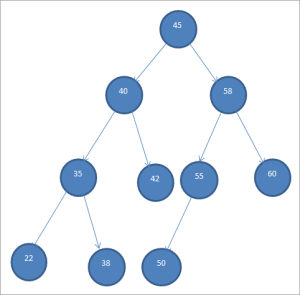
Binary search trees are a fundamental data structure used to construct more abstract data structures such as sets, multisets, and associative arrays.
Operations:
Insert(int n) : Add a node the tree with value n. Its O(lgn)
Find(int n) : Find a node the tree with value n. Its O(lgn)
Delete (int n) : Delete a node the tree with value n. Its O(lgn)
Display(): Prints the entire tree in increasing order. O(n).
Detail Explanations for the Operations:
Find(int n):
- Its very simple operation to perform.
- start from the root and compare root.data with n
- if root.data is greater than n that means we need to go to the left of the root.
- if root.data is smaller than n that means we need to go to the right of the root.
- if any point of time root.data is equal to the n then we have found the node, return true.
- if we reach to the leaves (end of the tree) return false, we didn’t find the element
Search()
Searching a node in binary search is very easy. You just need to traverse left (if smaller) and right (if greater) according to value to be found.
Algorithm:
- If node to be found is equal to root, then search is successful
- If node to be found is smaller than root , then traverse left subtree.
- If node to be found is greater than root, then traverse right subtree
- Repeat above steps recursively until you find the node.
Insert()
Insert node operation is also easy operation. You just need to compare it with root and traverse left (if smaller) or right(if greater) according to value of node to be inserted.
Algorithm:
- Make root node as current node
- If node to be inserted < root
- If it has left child then traverse left
- If it do not have left child, insert node here
- If node to be inserted > root
- If it have right child, traverse right
- If it do not have right child, insert node here.
Order-based methods and deletion.
An important reason that BSTs are widely used is that they allow us to keep the keys in order. As such, they can serve as the basis for implementing the numerous methods in our ordered symbol-table API. Learn more programming skills from Learn Java Online
- Minimum and maximum: If the left link of the root is null, the smallest key in a BST is the key at the root; if the left link is not null, the smallest key in the BST is the smallest key in the subtree rooted at the node referenced by the left link. Finding the maximum key is similar, moving to the right instead of to the left.
- Floor and ceiling: If a given key key is less than the key at the root of a BST, then the floor of key (the largest key in the BST less than or equal to key) must be in the left subtree. If key is greater than the key at the root, then the floor of key could be in the right subtree, but only if there is a key smaller than or equal to key in the right subtree; if not (or if key is equal to the key at the root) then the key at the root is the floor of key. Finding the ceiling is similar, interchanging right and left.
- Selection: Suppose that we seek the key of rank k (the key such that precisely k other keys in the BST are smaller). If the number of keys t in the left subtree is larger than k, we look (recursively) for the key of rank k in the left subtree; if t is equal to k, we return the key at the root; and if t is smaller than k, we look (recursively) for the key of rank k – t – 1 in the right subtree.
- Rank: If the given key is equal to the key at the root, we return the number of keys t in the left subtree; if the given key is less than the key at the root, we return the rank of the key in the left subtree; and if the given key is larger than the key at the root, we return t plus one (to count the key at the root) plus the rank of the key in the right subtree.
- Delete the minimum and maximum: For delete the minimum, we go left until finding a node that that has a null left link and then replace the link to that node by its right link. The symmetric method works for delete the maximum.
- Delete: We can proceed in a similar manner to delete any node that has one child (or no children), but what can we do to delete a node that has two children? We are left with two links, but have a place in the parent node for only one of them. An answer to this dilemma, first proposed by T. Hibbard in 1962, is to delete a node x by replacing it with its successor. Because x has a right child, its successor is the node with the smallest key in its right subtree. The replacement preserves order in the tree because there are no keys between x.key and the successor’s key. We accomplish the task of replacing x by its successor in four (!) easy steps:
- Save a link to the node to be deleted in t
- Set x to point to its successor min(t.right).
- Set the right link of x (which is supposed to point to the BST containing all the keys larger than x.key) to deleteMin(t.right), the link to the BST containing all the keys that are larger than x.key after the deletion.
- Set the left link of x (which was null) to t.left (all the keys that are less than both the deleted key and its successor).
Advantages:
- Compared to linear search (checking each element in the array starting from the first), binary search is much faster. Linear search takes, on average N/2 comparisons (where N is the number of elements in the array), and worst case N comparisons. Binary search takes an average and worst-case log2(N)log2(N) comparisons. So for a million elements, linear search would take an average of 500,000 comparisons, whereas binary search would take 20. For more details Java Certification Course
- It’s a fairly simple algorithm, though people get it wrong all the time.
- It’s well known and often implemented for you as a library routine.
Disadvantages:
- It’s more complicated than linear search, and is overkill for very small numbers of elements.
- It works only on lists that are sorted and kept sorted. That is not always feasable, especially if elements are constantly being added to the list.
- It works only on element types for which there exists a less-than relationship. Some types simply cannot be sorted (though this is rare).
- There is a great lost of efficiency if the list does not support random-access. You need, for example, to immediately jump to the middle of the list. If your list is a plain array, that’s great. If it’s a linked-list, not so much. Depending on the cost of your comparison operation, the cost of traversing a non-random-access list could dwarf the cost of the comparisons.
- There are even faster search methods available, such as hash lookups. However a hash lookup requires the elements to be organized in a much more complicated data structure (a hash table, not a list).
Example:
Class BinarySearchTree {


    class Node {
        int key;
        Node left, right;

        public Node(int item) {
            key = item;
            left = right = null;
        }
    }


    Node root;


    BinarySearchTree() {
        root = null;
    }

    void insert(int key) {
       root = insertRec(root, key);
    }


    Node insertRec(Node root, int key) {

                if (root == null) {
            root = new Node(key);
            return root;
        }


        if (key < root.key)
            root.left = insertRec(root.left, key);
        else if (key > root.key)
            root.right = insertRec(root.right, key);

                return root;
    }


    void inorder()  {
       inorderRec(root);
    }

        void inorderRec(Node root) {
        if (root != null) {
            inorderRec(root.left);
            System.out.println(root.key);
            inorderRec(root.right);
        }
    }

        public static void main(String[] args) {
        BinarySearchTree tree = new BinarySearchTree();

        tree.insert(50);
        tree.insert(30);
        tree.insert(20);
        tree.insert(40);
        tree.insert(70);
        tree.insert(60);
        tree.insert(80);

        tree.inorder();
    }
}
To get in-depth knowledge, enroll for a live free demo on Java Online Training
 java programming